Showing posts with label review. Show all posts

Monday, June 27, 2016

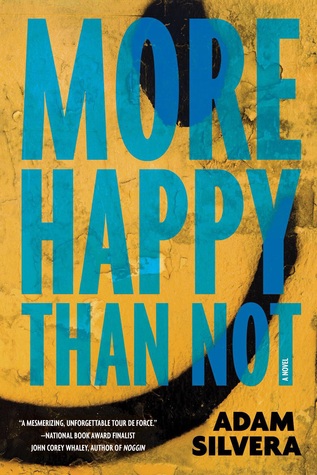
Review: More Happy Than Not


Title: More Happy Than Not
Author: Adam Silvera


Series: None
Length: 293 Pages 
Published by: Soho Teen
Publication Date: February 7, 2012 
Diversity: LGBT+ protagonist, LGBT+ romantic interest, main characters are POC, heavy exploration of socioeconomic class divisions, deals heavily with mental illness, intersectional #ownvoices
Rating: 

(This information is regarding the print version. I read this as an ebook through Axis 360, which is an eBook lending application that I highly recommend using if your library participates in it!)


       I'm going to preface this by saying that I've read some pretty fucked up books in my 17 years, and this one takes the cake. More Happy Than Not is a heavy book from multiple angles. It's about an impoverished teenager named Aaron Soto who inhabits a housing project in the Bronx, where his family has lived for years. He rents a tiny apartment with his mom and brother where they all try their best to get by, surrounded by the community they have been a part of for as long as Aaron can remember. He's been going through some pretty rough stuff after his father's suicide and his own attempt on his life, but he's finally moving forward. After Aaron makes a connection outside his project, it creates tension between him and his friends, and as their friendship develops, tension between Aaron and his endlessly supportive girlfriend. Eventually, his feelings about Thomas get so mixed up that he decides his only hope for a normal life is an experimental memory-alteration procedure. 

     There's not much further I can go without spoiling some things, but some pretty fucked up stuff happens later on. This book deals with quite a few serious subjects, including mental illness, grief, poverty, violence, and hate crimes. The commentary gets pretty sophisticated at some points, especially considering that Aaron's internal monologue is often focused on what he can and cannot afford- the socioeconomic commentary is almost nonstop.
      
     However, the writing style of More Happy Than Not was something I really disliked. There was absolutely no fluff, and I don't really remember it being anything but literal. Much of the book didn't feel real, and I didn't ever feel truly present in the setting. The writing consisted mainly of dialogue, Aaron's internal monologue, and sex mentions. Occasionally Aaron would get a little poetic over his love for others, but that was the maximum amount of fluff. I know I complain when novels have too much sensory detail, but this one just didn't have enough for me. It felt a little too simplistic, although that worked in its favor by making the novel easily understood. If you prefer a minimal-frills writing style, you'll probably love this aspect.

     Additionally, some of the plot seemed a little simplistic and a tad bit campy. Even with the plot twists, it went in a pretty simple sequence of events. It was pretty fixated on one certain event from the past, and everything stemmed from That Traumatic Event even when it didn't quite make sense to me that 2 + 2 = eternal manpain. Oh, and there's a lot of manpain. It was pretty well-justified trauma, but still quite a bit of mainpain.

     One thing that worked both for and against this novel was the realism of the teenage boys. Most of the major characters are stereotypical teenage boys and depicted as such. Much of the novel was centered around teenage boys, and the realism was impeccable, from what I know of stereotypical horny teenagers. That said, they talk about sex ALL THE TIME. I got SO TIRED of hearing the guys talk about banging throughout the entire first third of the book. After a while, I became kind of numb to all of the casual mentions of DICK. There's no actual smut, but if sex mentions make you uncomfortable this may not be the book for you.

    Overall, this was an Important Book. Just like The Miseducation of Cameron Post, I may not have liked More Happy Than Not, but am glad that it exists, even if it felt kind of campy to me. Don't let my issues with this book discourage you from reading it if it sounds like your cup of tea. I would recommend it if you're looking for a book with an LGBT+ protagonist that's uncommonly dark with extremely sophisticated commentary and a minimalist writing style. Additionally, this is an intersectional #ownvoices book- here's a link to Adam Silvera's page on Goodreads! More Happy Than Not is not a book for everyone, and it's not one of the most fluffy or happy books I've ever read, but feel free to give it a shot and tell me what you think!


Tuesday, May 24, 2016

Book Review: The Miseducation of Cameron Post


Title: The Miseducation of Cameron Post
Author: Emily M. Danforth

Series: None
Length: 470 pages 
Published by: Balzer + Bray
Publication Date: February 7, 2012 
Diversity: LGBT+ protagonist, LGBT+ romantic interest(s), Native American minor character, minor character is an amputee, Bechdel Test, Mako Mori Test
Rating: 


    This is one of those books that I heard talked about mostly in the context of "This is an Important Book,". It's about a girl living in rural Montana coping with the death of her parents while surviving as a lesbian surrounded by narrow religious folks. She does alright with it... Until Aunt Ruth finds out. Now, I don't normally read books just because they're Important, so I mainly read The Miseducation of Cameron Post because, if we're being honest, I'll take almost any LGBT book that I can find, especially one with no queer deaths. The shortest way I can manage to describe it is as a doozy of a novel.
     
     The frustrating this about this book was that it was just so long. More than a third of the book leads up to the main story, which is the part mentioned in the synopsis. While the exposition was incredibly poetic and beautifully written, it felt tedious after a 100 or so pages. The first half moved almost painfully slowly, especially because I knew what was inevitably going to happen. There was kind of an odd disconnect in the fact that the synopsis made the conversion camp sound like the main point of the book while I was making my way through pages and pages of exposition, just waiting for the bad things to happen. Admittedly, Emily M. Danforth's dreamy description of Cameron Post's childhood and adolescence made me almost want to be a rural Montana lesbian breaking the law with her attractive cowgirl girlfriend, but as I waited and waited for Aunt Ruth to find out, the dramatic irony got really tiresome.
    
     While there were many aspects of this novel that I disliked, it would be an insult to the book to not mention the absolutely beautiful writing style. Although it feels excessively detailed at many points, the writing is full of intricate sensory descriptions and Cameron's point of view is very detailed. For the most part, it doesn't feel flowery or fluffy- much of it is incredibly simplistic. Much of the first half of the book felt almost impressionistic, despite its volume. Particularly during the portions covering Cameron's childhood, it was impossible to not feel present in Danforth's visualization. 

   In my opinion, Danforth also excelled at painting characters who managed to be both realistic and absurd. This made the second half of the novel worth it for me. From Jamie to Jane, and Viking Erin to Adam, this book contained a host of genuinely likable (as well as not-so-likable) characters. The pure absurdity of many of the characters detracted from some of the realism of the story, but in a good way, providing welcome relief from some of the more serious events of the second half.

   The Miseducation of Cameron Post was not a bad read, but the lengthy exposition really killed it for me. It would have been less of a tedious process had the exposition been shorter. However, it has definite literary merit and is worth checking out. If you're looking to read this purely for the subject matter of conversion therapy, don't. You'll be frustrated by the extensive storytelling in Cameron's lengthy childhood and adolescence. But anyone willing to press through the slow-moving plot in order to uncover a host of wonderful characters will likely find many things to appreciate in this emotional book.

(Warning: If you have major issues with body horror and/or descriptions of blood, there is an incident in the last third of the book that you might find distressing. Feel free to contact me if you're concerned.)

Friday, January 22, 2016

Review: Willful Machines by Tim Floreen


  Title: Willful Machines
     Author: Tim Floreen
     Series: None (but the author hopes to continue the story)
     Length: 370 pages 
     Published by: Simon Pulse
     Publication Date: October 20th, 2015 
     Diversity: LGBT+ protagonist, romantic interest is both LGBT+ and a POC, some
     minor characters are POC, Bechdel Test (which I normally let male-narrated 1st 
     person books slide on, but this was a pleasant surprise)
     Rating: ★★★★


     A while back, I remember encountering someone on social media asking some of the same questions that this book asks. What does it mean to be human? And if you found out that a robot had a consciousness, would you be willing to fight for its rights?

     I didn't have these questions in mind when I picked up this book. It had a cool cover, interesting premise, and what appeared to be a promise of a gay romance subplot, all strong criteria that I take into consideration when choosing a book. And I didn't expect much more than a typical YA thriller-type novel with some gay on the side. This turned out to be so much more, especially when Charlotte's motive was revealed. It ended up being an interesting discussion of human rights, free will, motivation, and the definition of humanity, all wrapped up in a novel that managed to be a combination of sci-fi, thriller, romance, and coming-of-age while still being coherent.

     It's true that I personally preferred the examinations of humanity, especially Lee's conversations with Dr. Singh, and would have liked a bit more of that instead of the overbearing "fear the robots!" parts, but the balance worked out in the end. It was also awesome how fresh the world felt. It wasn't quite a dystopia, but it wasn't ideal either. Robo-terrorism, anyone? The whole idea of near-future conservatism opposing robot rights within a world where not all current social issues were solved (i.e. all women's rights, lgbt+, and racial issues aren't magically resolved in this world) felt realistic. Also, I hate it when near-future stories make the departure from current technology really extreme, and the fact that I could picture all of the technology in this book being used a century or so from now contributed to the realism factor.

     However, I did have some issues with how Lee's mental illness was written, especially in the resolution. Not to be spoilery, but it felt almost flippant how it was resolved.

     Other than the facts that the writing did feel a little campy at times, Lee's mental illness could have been written more sensitively, and the pacing felt inconsistent (slow at the beginning, a wild ride at the end), this was a good read. If you're interested in surprisingly deep young adult fiction and down with both heavy action and philosophical discussion, I'd totally recommend it.